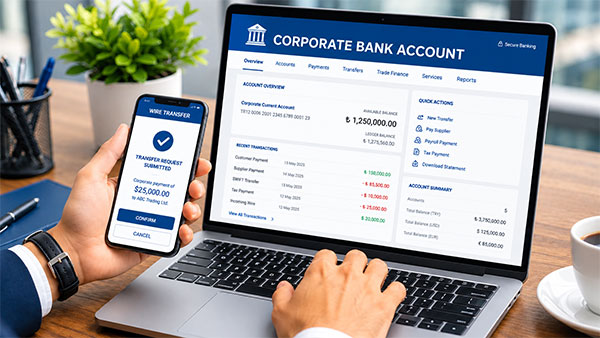
For foreign companies entering the Turkish market, establishing a reliable banking relationship is an important part of setting up and operating a business.
A corporate bank account allows a company to receive payments, pay suppliers and employees, manage taxes and expenses, transfer funds, and maintain a clear record of its business transactions. For foreign companies, opening a corporate bank account in Turkey is therefore an important part of establishing local operations.
Turkish banks apply their own customer acceptance, Know Your Customer (KYC), anti-money laundering and risk assessment procedures. For foreign-owned companies, these checks may involve additional information concerning shareholders, directors, ultimate beneficial owners and the company's business activities.
For this reason, foreign investors should understand the banking process before establishing their Turkish business structure.
Can Foreign Companies Open a Corporate Bank Account in Turkey?
Yes. Foreign investors can establish companies in Turkey and operate through Turkish corporate bank accounts.
However, company incorporation and bank account approval are separate processes.
A company may be legally incorporated in Turkey, but this does not automatically mean that every bank will accept the company as a customer. Each bank applies its own internal compliance and customer acceptance procedures.
For foreign investors who are still planning their Turkish operations, completing the appropriate company registration in Turkey is generally an important first step before establishing the company's banking relationship.
The bank will typically want to understand the company's ownership, management, business activity and expected transactions.
Questions may include:
- Who owns the company?
- Who ultimately controls the company?
- What does the company do?
- Where will its funds come from?
- Which countries will it transact with?
- What type of transactions are expected?
- Who will be authorized to operate the account?
Preparing clear answers to these questions can make the banking process more efficient.
What Documents Are Usually Required?
The exact requirements vary between banks and customer profiles. However, foreign-owned Turkish companies should generally be prepared to provide corporate and identification documents.
These may include:
- Trade Registry records
- Trade Registry Gazette
- Tax registration documents
- Articles of Association
- Signature circular
- Identification documents of authorized signatories
- Shareholder information
- Ultimate beneficial owner information
- Corporate ownership documents
- Information about the company's business activity
- Supporting information concerning the source of funds
- Documents relating to foreign shareholders or parent companies
Foreign documents may need to be apostilled or legalized and translated into Turkish, depending on the document and the bank's requirements.
It is therefore advisable to determine the bank's documentation requirements before submitting an application.
KYC and Ultimate Beneficial Owner Checks
One of the most important parts of corporate banking in Turkey is the KYC process.
KYC means Know Your Customer. Banks use KYC procedures to identify customers, understand their activities and assess potential financial crime risks.
For a foreign-owned company, the bank may need to identify the ownership structure through to the ultimate beneficial owner.
For example, if a Turkish company is owned by a foreign company, the bank may request information about the foreign parent company and its shareholders.
If the ownership chain is complicated or the information in different documents is inconsistent, the bank may request additional documentation.
A clear and well-documented ownership structure can therefore help reduce unnecessary delays.
Choosing the Right Bank in Turkey
Foreign companies should not necessarily choose a bank simply because it is one of the largest banks in Turkey.
The appropriate bank depends on the company's actual business model and banking requirements.
Important considerations may include:
International Transfers
Companies dealing with international customers and suppliers should consider the bank's international transfer capabilities.
Foreign Currency Accounts
Businesses working with international customers may require EUR, USD or GBP accounts in addition to TRY accounts.
Online Corporate Banking
A reliable online banking platform can be particularly important when company management is located outside Turkey.
Corporate Cards
Companies may need corporate cards for business expenses, travel, employee expenses and management costs.
Trade Finance
Importers and exporters may require letters of credit, bank guarantees, foreign trade finance or other specialized banking products.
Cash Management
Companies with significant transaction volumes may benefit from corporate cash-management services.
BanksDAILY's Turkey directory itself lists numerous Turkish institutions offering corporate, commercial, international and foreign-trade banking services, illustrating the range of banking options available to businesses operating in Turkey.
Why Can a Corporate Bank Account Application Be Delayed?
A legally established company may still experience delays during the bank onboarding process.
This does not necessarily indicate that there is a problem with the company.
Banks conduct their own risk assessments and may request additional information before making a customer acceptance decision.
Common reasons for delays include:
- Incomplete corporate documents
- Unclear ownership structure
- Missing UBO information
- Inconsistent company information
- Unclear business activity
- Insufficient explanation of expected transactions
- Unclear source of funds
- International transactions involving higher-risk jurisdictions
- Documents requiring legalization or translation
- Additional compliance reviews
The best approach is to prepare a complete banking file before approaching the bank.
Corporate Banking and International Transactions
International companies operating in Turkey may need to send and receive funds across borders.
Typical transactions can include:
- Payments from international customers
- Payments to foreign suppliers
- Capital contributions
- Intercompany transactions
- Service payments
- Dividends
- Loans
- Management fees
- Foreign currency transactions
Banks may request supporting documentation depending on the nature and size of a transaction.
Companies should therefore maintain appropriate contracts, invoices and other commercial documentation supporting significant international payments.
International transactions should also be properly reflected in the company's accounting and tax records.
Corporate Banking and Accounting
Banking should not be treated as an isolated administrative function.
A company's bank transactions should generally be consistent with its accounting records, invoices, contracts and business activities.
For example, if a company receives payments from overseas customers, the underlying commercial transaction should be properly documented and recorded.
Similarly, payments to suppliers, employees and government authorities should be properly reflected in the company's accounting records.
This makes coordination between corporate banking and accounting particularly important for foreign-owned companies.
Corporate Banking and Tax Compliance
Corporate banking also interacts closely with tax compliance.
A company's banking transactions can form an important part of its financial records and may need to be reconciled with invoices, accounting entries and statutory reporting.
Foreign companies should therefore establish procedures that connect:
- Corporate banking
- Accounting
- Tax reporting
- Payroll
- Supplier payments
- Customer collections
- International transfers
A well-organized financial structure can make it easier to monitor cash flow and maintain accurate records.
Can Foreign Companies Open Accounts Remotely?
Whether a bank account can be opened remotely depends on the bank, the company structure and the specific customer profile.
Some procedures may be handled through a representative or power of attorney, while a bank may require physical attendance for certain identification, signature or onboarding procedures.
Foreign investors should therefore confirm the bank's requirements before travelling to Turkey.
This can be particularly important when the shareholders or directors are based overseas.
Corporate Banking for Newly Established Companies
Banking should ideally be considered during the company establishment process rather than only after incorporation has been completed.
A practical sequence can include:
- Determine the appropriate Turkish company structure.
- Complete the company registration process.
- Obtain tax registration.
- Prepare Trade Registry and corporate documents.
- Identify shareholders and ultimate beneficial owners.
- Prepare information about the company's business model.
- Select appropriate banks.
- Prepare the corporate banking application.
- Complete the bank's KYC and compliance procedures.
- Establish authorized signatory arrangements.
- Activate online corporate banking.
- Coordinate banking transactions with accounting and tax processes.
Early preparation can significantly reduce administrative delays.
What Foreign Companies Should Prepare Before Applying
Before approaching a bank, a foreign company should prepare a clear corporate profile.
The profile should explain:
- The company's business activity
- Target customers
- Main suppliers
- Expected transaction countries
- Expected transaction volumes
- Source of initial capital
- Ultimate beneficial ownership
- Purpose of the Turkish company
- Expected use of the bank account
The information should be consistent with the company's corporate documents.
For example, if a company is registered to provide software services but describes itself to the bank as an import-export business, the difference may lead to additional questions.
Consistency is therefore an important part of a successful banking application.
Why Corporate Banking Matters for Foreign Investors
For an international business, a Turkish corporate bank account is more than simply an account number.
The banking relationship needs to support the company's actual commercial activities.
Depending on the business, this may include:
- Receiving customer payments
- Paying suppliers
- Paying employees
- Paying taxes
- International transfers
- Foreign currency transactions
- Corporate cards
- Trade finance
- Cash management
The company should select a banking structure that fits its expected operations rather than simply choosing the first available account.
Final Thoughts
Corporate banking in Turkey is an important consideration for foreign companies establishing or expanding their operations in the country.
Foreign investors can establish Turkish companies and operate through corporate bank accounts, but bank account approval remains subject to each bank's own KYC, compliance and risk assessment procedures.
The most effective approach is to prepare the company's corporate documents, ownership structure, business profile and expected transaction model before applying.
Foreign companies should also ensure that their banking activities are properly coordinated with accounting and tax processes.
With appropriate preparation, corporate banking can become a manageable and effective part of operating a business in Turkey.
About A&M Consulting Co.
A&M Consulting Co. provides accounting, tax, payroll, corporate compliance and business consultancy services in Turkey for foreign investors and international companies.
The firm assists international businesses with company establishment, corporate banking support, accounting, tax compliance, payroll and ongoing regulatory requirements in Turkey.
Date: 14.09.2026
Get your content published on BanksDAILY.com in just a few clicks.
- Updatings
- Bordier et CieOctober 4, 2026
- Choice BankOctober 2, 2026
- Bank South Pacific (BSP)October 2, 2026
- Novo BancoOctober 1, 2026
- Al Barid BankSeptember 30, 2026
Smart Investing
Buy $BD digital coins and become an essential part of the BanksDAILY project! We create a culture of ownership using secure and fast blockchain technology!
More info...