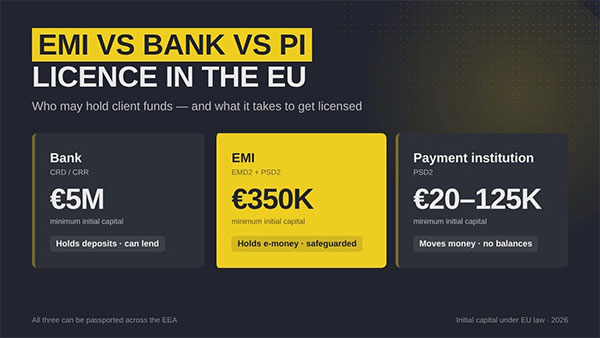
A bank and an electronic money institution (EMI) can both open accounts with an IBAN, issue payment cards and move money across the EU. From the client's side, the two can look identical. The difference is what the institution may do with client money. A bank takes deposits and lends them out. An EMI must keep client money safeguarded, cannot lend it and cannot pay interest on it. That one difference shapes everything else: initial capital (€5 million for a bank, €350,000 for an EMI), ongoing own funds, supervision, application timelines and cost.
This guide compares the three licences a fintech usually considers. One is a bank licence. The other two are EU payment licences: an electronic money institution (EMI) licence and a payment institution (PI) licence. It explains when a PI licence is enough, how much capital each licence needs, how safeguarding and EU passporting work, what regulators check, how long it takes and what it costs, why applications get delayed, what the PSD3 reform will change, and when you can start without a licence of your own.
EMI vs bank vs payment institution: the key differences
Banks are licensed under the Capital Requirements Directive and Regulation (CRD/CRR). EMIs are licensed under the Second E-Money Directive (EMD2), and payment institutions under the Second Payment Services Directive (PSD2). The main differences:
Bank (credit institution) |
EMI |
Payment institution |
|
|---|---|---|---|
Legal basis |
CRD / CRR |
EMD2 + PSD2 |
PSD2 |
|
What it does with client money |
Holds deposits and lends them out to other clients |
Holds client balances (wallets, prepaid cards) and moves money — but cannot lend or invest it |
Moves money from payer to payee — does not hold client balances |
|
Typical products |
Current and savings accounts, loans, mortgages |
Wallets, multi-currency accounts, prepaid and debit cards, IBANs |
Card acquiring, payment gateways, remittance, marketplace payouts |
|
Minimum initial capital |
€5 million (lower only in limited cases) |
€350,000 |
€20,000–€125,000, depending on the services |
|
Ongoing own funds (the buffer you must keep as the business grows) |
Set by risk-weighted capital ratios and liquidity rules under CRR |
At least 2% of the client money you hold, and never below €350,000 |
A percentage of your costs, payment volume or income, set by the regulator, and never below the initial capital |
|
Client protection |
Deposit guarantee up to €100,000 per depositor; deposits can earn interest |
Funds safeguarded in a separate account or by insurance; no deposit guarantee; no interest allowed |
Funds safeguarded in a separate account or by insurance; no deposit guarantee, no interest — the PI holds no balances |
|
Lending |
Yes |
Only short-term credit tied to a payment, for up to 12 months, and never from client funds |
Same as EMI |
|
Can issue euro stablecoins (e-money tokens under MiCA) |
Yes |
Yes |
No |
|
EU passport |
Yes |
Yes |
Yes |
|
Legal deadline for the regulator's decision |
6 months, 12 months at most |
3 months after a complete application |
3 months after a complete application |
For most fintechs, a bank licence is out of reach, and the €5 million of initial capital is only part of the reason. A bank must also meet ongoing capital and liquidity ratios, have its board and senior managers approved by the supervisor, run separate risk, compliance and internal audit functions, keep a recovery plan, report under the full prudential framework and pay into the deposit guarantee scheme. These are monthly costs that start long before the licence pays for itself. That is why most fintechs start with an e-money or payment licence and apply for a bank licence only once they have scale. Revolut took this route: it began as an e-money company and got its EU bank licence in 2018. Wise never made the switch: it still serves customers across the EEA under a Belgian payment licence. So the practical question is usually narrower: EMI or payment institution?
Electronic money institution vs payment institution: which licence do you need?
The simple test: does the client's money stay with you?
If clients top up a balance and spend it later, you issue e-money and need an EMI licence.
If money only passes through you on its way to the recipient, a payment institution (PI) licence is usually enough, and it needs less capital.
Typical cases:
Wallets, neobank-style and multi-currency accounts — EMI.
Prepaid cards, or debit cards that spend from a stored balance — EMI.
Crypto on- and off-ramp where clients hold fiat balances — EMI for the fiat side; the crypto side needs a separate MiCA licence.
Payment gateway or merchant acquiring — usually PI.
Marketplace payouts — PI, unless sellers keep a balance with you.
Money remittance only — PI, €20,000 capital.
Payment initiation only — PI, €50,000 capital.
Account information only — registration, not a full licence.
Which one to start with? An EMI licence also covers payment services, so you never need both. If your plans include wallets or cards, apply for the EMI licence straight away: moving from PI to EMI later means a new application, not an upgrade. If the model only moves money and capital is tight, a payment institution licence is the cheaper start.
Both regimes also have a small version. A small EMI can hold up to €5 million of e-money on average (some countries set a lower cap), and a small PI can process up to €3 million a month. The catch is that neither can passport, so you work in one country only. A small EMI licence is a practical way to test a model at home before applying for a full licence.
Capital requirements: initial capital vs own funds
Initial capital is what you pay in to get the licence. Own funds are what you must keep in the company afterwards: a safety cushion that grows with the business, so that losses never eat into client money. It can never drop below the initial capital, and regulators check it regularly.
How the cushion grows:
-
EMI — at least 2% of the money clients hold with you on average. With €20 million of client balances, that is €400,000, already more than the €350,000 initial capital. At €50 million, it is €1 million.
-
Payment institution — based on your costs, payment volume or income. The regulator picks the formula that fits your model.
-
Bank — measured against the risk of its loans and other assets, with extra buffers on top. That means far more capital and reporting.
Safeguarding requirements: how EMIs and payment institutions protect client money
A bank can lend out its clients' deposits. An EMI cannot: it must keep client money apart from its own and protected. This is called safeguarding, and it is the main rule of an e-money licence. Money received by card must be safeguarded within five business days at the latest.
Payment institutions have the same duty. Money only passes through them, but if it has not reached the recipient by the end of the next business day, it must be safeguarded too.
There are two ways to do it:
-
Segregation. Client funds sit in a separate account at a bank, or in safe, liquid assets, apart from the company's own money.
-
Insurance or guarantee. An insurer, or a bank outside your group, covers the client funds.
If the firm goes bankrupt, safeguarded money goes back to clients, not to the company's creditors. This is what clients get instead of a bank's €100,000 deposit guarantee. Regulators usually expect regular checks that client balances match the safeguarding account, a written safeguarding policy, and audits.
The hard part is finding a bank. Both EMIs and payment institutions need a safeguarding account, and many banks treat payment firms as high-risk clients. PSD2 requires banks to give them fair access to accounts and to explain any refusal to the regulator, but the search can still take months. Start it together with the licence application, not after.
EU passporting: one licence, 30 markets
A full EMI or PI licence from one EU country lets you serve clients across the whole European Economic Area: the 27 EU states plus Norway, Iceland and Liechtenstein. You don't need a second licence. You tell your home regulator which countries and services you plan to cover, and it passes this on to the other regulators. This usually takes up to three months.
Small EMIs and small payment institutions cannot passport. They can only work in the country that issued the licence.
Because one licence opens the whole market, the choice of home country depends on the regulator, not on the size of the local market. Fintechs look at how fast and predictable the process is, what it costs to run the company, and whether local banks open safeguarding accounts. One example is an EMI licence in the Czech Republic: the Czech National Bank supervises banks, payment firms, EMIs and crypto firms under MiCA in one place, the official application fee is CZK 20,000 (about €800), and the licence can be passported across the EEA.
EMI and PI licence requirements: what regulators check
The application file follows PSD2 and is broadly the same across the EU for EMIs and payment institutions:
a programme of operations and a business plan with a three-year budget forecast;
proof of initial capital and where the money comes from;
the safeguarding set-up, including the safeguarding bank or insurer;
governance, internal control and risk management;
AML/CFT procedures and the appointment of a compliance officer or MLRO;
security policy, incident handling and business continuity;
fit-and-proper documents for directors and major shareholders;
a head office in the licensing country;
outsourcing arrangements and the statutory auditor.
EMI and PI licence: timeline and cost
By law, the regulator must decide within three months, but the clock starts only once your application is complete. In practice, plan for:
2–3 months to prepare: set up the company, appoint directors and an MLRO, write the business plan and policies;
3–6 months of review, with one or two rounds of questions. Complex ownership structures can take up to a year.
A realistic total is 6–9 months.
The biggest cost is capital: €350,000 for an EMI, €20,000–125,000 for a payment institution. On top of that come professional fees for preparing the application, usually tens of thousands of euros, and running costs once you are licensed: compliance staff, AML software, audits and regulatory reporting. The state fee itself is small.
Why EMI and PI applications get delayed or refused
A straight refusal is rare. Usually the regulator sends questions or points out gaps, gives a deadline to fix them, and stops the review clock until you reply. If the gaps are not fixed in time, the process is usually stopped and no licence is granted. The company can then appeal or apply again with a better file. Most of these questions come down to six issues.
1. A business plan that does not add up
Many applicants know their product well but cannot show their business in numbers. The regulator reads the three-year forecast very critically. Are the client numbers realistic for the marketing budget? Are fees in line with the market? Does capital grow with client money? For an EMI, a plan to hold €50 million of client money by year two needs about €1 million of own funds, not €350,000. The plan must also fit the licence: if you apply for an EMI licence but show no wallets or cards, the regulator will ask why you need one.
2. No bank for safeguarding client money
Banks are cautious with payment firms, and applicants feel this twice. First, even opening an account to pay in the share capital can take months. Then comes the safeguarding account for client money, which is harder still: many banks do not want to work with a payment firm that has no licence yet. That is why the search for a bank should start as early as possible.
3. No real presence in the licensing country
By law, the head office must be in the country that grants the licence. A local address with one nominee director, while the business is really run from abroad, usually raises questions. Regulators want to see that key decisions are made in that country and that management is available for an interview. Exact expectations differ from country to country. You can outsource, but you must show you still control what you outsource.
4. AML on paper only
A common weak point is generic AML policies: bought as a template or reused from another company's application and never adapted to the actual business. Regulators spot this quickly. They want three things: a risk assessment that matches your real products and client countries; clear rules on which transactions trigger alerts and who reviews them; and an MLRO with real experience in payments or banking compliance.
5. Unclear source of funds and ownership
This is one of the most closely checked parts of the application. The regulator wants to know who really owns the company and where every euro of the capital came from. Each major shareholder must document how the money was earned, with bank statements, tax returns, sale contracts or dividend records, and the check goes up the whole ownership chain to the ultimate owner. Structures that hide the real owner, such as trusts or nominee shareholders, and capital funded by a loan usually lead to long rounds of questions.
6. Weak IT and DORA documentation
The software must already be in place, not just planned, and it must be properly described: how the system works, who provides it, how incidents are handled and reported under DORA, and what happens if a key provider fails. Two pages of text, or a provider's sales deck instead of a real description, will be sent back.
The common thread: the regulator is not checking whether you know the rules, but whether your company will actually work on the day the licence is issued.
What PSD3 and the PSR will change
The EU is rewriting its payment rules. PSD2 and EMD2 will be replaced by a new directive (PSD3) and a regulation (PSR) that applies directly in every member state. The final texts were agreed in 2025–2026, and the new rules will apply about 21 months after they enter into force, so not before 2028.
Three changes matter most for fintechs:
-
One licence regime. E-money becomes a payment service, and EMIs move into the payment institution framework. Existing EMIs and PIs get a transition period to show they meet the new rules, so they will not have to start from scratch.
-
A new safeguarding option. Client money can be held at a central bank, where the central bank offers such accounts.
-
Some capital changes. For example, firms offering only money remittance will need €40,000 instead of €20,000.
For a fintech applying now, the conclusion is simple: apply under the current rules, but build safeguarding, reporting and AML so they carry over to the new framework without a rebuild.
Alternatives to applying for your own licence
Not every fintech has to start with its own application. Two other routes are common:
-
Work under a licensed partner. A payment institution can offer its services through registered agents, and an EMI can use distributors to sell and redeem its e-money. You can launch sooner, but the partner holds the licence, sets the rules and can end the relationship.
-
Buy an existing licensed company. A ready-made EMI or PI, where one is available, saves time on the application itself. The regulator must still approve the new owners first, with the same fit-and-proper and source-of-funds checks as a new application, and you take over the company's history, so check it carefully.
FAQ
What is an electronic money institution?
An electronic money institution (EMI) is a company licensed to issue electronic money: money that clients hold in a wallet, account or prepaid card and use for payments. It can also provide payment services. EMIs are licensed under the
Second E-Money Directive (EMD2) and supervised by the national regulator.
What is the difference between an EMI and a bank?
A bank takes deposits and lends them out. An EMI must keep client money safeguarded and cannot lend it or pay interest on it. A bank needs at least €5 million of initial capital, while an EMI needs €350,000.
What is the difference between an EMI and a payment institution?
An EMI can hold client balances, such as wallets and prepaid cards. A payment institution only moves money from payer to payee. A payment institution needs less capital: €20,000–125,000, depending on the
services.
Is money held by an EMI protected like a bank deposit?
No. There is no deposit guarantee. Instead, the EMI must safeguard client money, keeping it separate from its own funds, so that if the EMI goes bankrupt, the money goes back to clients and not to the company's creditors.
Can an EMI pay interest on client balances?
No. EU rules do not allow EMIs to pay interest on e-money.
Can an EMI issue IBANs and payment cards?
Yes. Many EMIs offer IBAN accounts and debit or prepaid cards, which is why they can look like banks from the client's side.
Can an EMI licence be used across the EU?
Yes. A full EMI licence can be passported to all EEA countries without a second licence. A small EMI licence cannot be passported and works only in the country that issued it.
How long does it take to get an EMI licence?
Usually 6–9 months, including preparation. The regulator has three months to decide, but only once the application is complete. Complex ownership structures can take up to a year.
How much does an EMI licence cost?
The largest item is the initial capital of €350,000. On top of that come professional fees for the application and running costs once licensed, such as compliance staff, audits and reporting. The state fee itself is small.
Can I buy a company that already has an EMI licence?
Sometimes, where such a company is available. The regulator must still approve the new owners, with the same checks on source of funds and fit-and-proper as in a new application.
About AMS Europe
AMS Europe is a Prague-based consultancy that helps fintech and crypto companies obtain EMI, payment institution and MiCA licences across the EU, and acquire ready-made licensed entities.
Date: 06.10.2026
Get your content published on BanksDAILY.com in just a few clicks.
- Updatings
- Citibank UAEOctober 6, 2026
- Bordier & Cie (UK)October 4, 2026
- RBA BankOctober 4, 2026
- Bordier et CieOctober 4, 2026
- Choice BankOctober 2, 2026
Smart Investing
Buy $BD digital coins and become an essential part of the BanksDAILY project! We create a culture of ownership using secure and fast blockchain technology!
More info...