The Ultimate Guide to Czech Koruna (CZK) Exchange
Understanding the Czech Koruna (CZK) exchange rate is the most critical step for anyone visiting or doing business in Czechia in 2026. The official currency of the country remains the koruna, and securing a favorable exchange rate significantly impacts the overall travel budget. When analyzing the currency market, monitoring the daily fluctuations set by the central bank is essential. Whether converting Euros, US Dollars, or British Pounds into CZK, knowing the mid-market rate provides a baseline for evaluating deals offered by local bureaus.
If expenses are priced in dollars, checking CZK to USD before exchanging money makes it easier to estimate the required budget accurately. A poor exchange strategy often leads to unnecessary financial losses that compound across every meal, museum ticket, and transit ride. Therefore, staying informed about the current currency trends in Czechia ensures maximum purchasing power, allowing travelers to focus on the journey rather than worrying about poor conversion values.
In August 2026, the CZK traded in a relatively stable band, showing a mild strengthening trend. The EUR/CZK pair hovered around 24.16–24.26, while the USD/CZK monthly averages sat between 20.67 and 21.03. The Czech National Bank (CNB) maintained a policy rate of 2.75% during this period, consistent with a normal-rate macroeconomic environment. The CNB's daily mid-market rate is primarily influenced by relative interest-rate expectations, domestic inflation, external balance, and global risk sentiment.
The official daily fixing is published every working day at approximately 2:30 p.m. local time. That specific rate remains valid for the current working day and covers all subsequent non-working days, serving as the single most reliable benchmark for evaluating any offer from a physical bureau, ATM, or airport kiosk.
Live Mid-Market Currency Converter Amount: From Currency: EUR - Euro USD - US Dollar GBP - British Pound Convert to CZK Result based on live mid-market rate will appear here.
Current Czech Koruna (CZK) Exchange Rates to Major Currencies
Before completing any transaction, always compare the local provider's offer against the baseline exchange rate. Monitoring this currency data daily helps identify fair exchange margins and avoid highly inflated rate markups at tourist hotspots. The table below displays the average CZK conversion metrics for major global currencies as of August 2026, contrasting the official mid-market rate with the typical range expected from legitimate Prague exchange offices.
Live CZK Exchange Rates vs. Acceptable Tourist Rates (August 2026)
| Currency (Code) | Live Mid-Market Rate (CZK) | Acceptable Tourist Bureau Rate (CZK) |
|---|---|---|
| Euro (EUR) | 24.205 | 24.00–24.40 |
| US Dollar (USD) | 20.947 | 20.50–21.10 |
| British Pound (GBP) | 28.434 | 27.70–28.40 |
| Singapore Dollar (SGD) | 16.440 | Data unavailable |
The SGD row highlights a specific market reality: no reliable Prague bureau quote for Singapore Dollars appeared in the standard 2026 financial data. Travelers arriving with SGD or other less commonly traded currencies find it safer and more cost-effective to convert their funds to EUR or USD prior to entering the Czech market. Mid-market rates are verified through the European Central Bank's reference data and the Czech National Bank's official fixing page.
Best Places to Exchange Money in the Czech Republic
Honest Exchange Offices (Směnárny) in Prague
The most reliable exchange offices in Prague are located slightly off the main tourist squares. Bureaus situated directly on Wenceslas Square or near the Charles Bridge typically incorporate exorbitant margins into their pricing models. Walking just five minutes away from these high-traffic corridors yields significantly better financial outcomes.
Reputable Prague exchange chains, including EXCHANGE s.r.o. (near Florenc and Štefánikova), Eurochange (on Opletalova 59), Nekázanka Exchange (Nekázanka 884/10), and X-Change Grossmann, advertise zero commission and consistently provide fair-rate transactions. These specific operators do not hide their profit margins within a sky-high spread.
A legitimate bureau clearly displays a single rate board without "buy" and "sell" discrepancies exceeding 2-3%. Using live Prague office quotes from August 2026, the typical acceptable margin is approximately 0.8–1.2 CZK above the fair reference rate for EUR, USD, and GBP. If a rate board shows a spread of 2+ CZK between buying and selling columns, the provider is applying an unfair markup. Always request a printed receipt detailing the transaction before handing over cash; Czech law permits customers to cancel an exchange transaction within three hours if provided with a substandard rate.
How to Exchange Travel Money for a Trip to Czechia: Cash, Cards, ATMs
Knowing how to exchange travel money for a trip to Czechia using a strategic mix of cash, cards, and ATMs is vital for a seamless experience. While digital payment methods are the default across Prague and major cities, carrying physical cash remains essential for specific situations.
Card payments are universally accepted in restaurants, supermarkets, hotels, museums, and public transport ticket machines. However, physical CZK is strictly required when dealing with cash-only merchants, such as small street food stalls, traditional neighborhood pubs, paid public toilets, and rural vendors operating outside areas with strong terminal coverage.
To optimize the travel budget, avoid currency exchange booths at airports or train stations entirely, as they consistently offer the worst margins of any legal provider. Instead, use a multi-currency debit card to withdraw local funds directly from a bank-operated ATM. This method usually provides the most competitive conversion values. When using a card for direct payment at restaurants or shops, always choose to pay in the local currency rather than the home currency to bypass exorbitant dynamic conversion markups. Balancing reliance on a travel card for large expenses while maintaining enough physical money for minor daily transactions represents the most secure and cost-effective financial strategy.
Currency Exchange Fees: How to Avoid Hidden Charges
Understanding currency exchange fees is crucial to figure out how to avoid hidden charges that quickly drain a travel budget. Many exchange bureaus prominently advertise a "0% commission" rate, but they hide their profit within a severely disadvantageous exchange spread. The fee remains invisible but extracts a heavy toll on the final converted amount.
To protect funds, always ask the teller for the exact final amount received before committing to the transaction. A transparent transaction clearly states both the applied rate and any fixed service fee upfront.
ATMs introduce a different layer of complex costs. Independent, non-bank machines — most visibly the bright yellow and orange terminals operated by Euronet — impose massive flat withdrawal fees alongside poor conversion margins. While domestic Czech cards might incur a flat fee of CZK 49 at these machines, foreign-card withdrawal fees escalate dramatically. Reports from 2026 indicate these independent ATMs charge foreign users anywhere from CZK 99 to CZK 239 per transaction. By prioritizing official bank ATMs operated by institutions like Česká spořitelna, ČSOB, Komerční banka, or Raiffeisenbank, travelers minimize unnecessary commission costs and keep their funds intact.
How to Avoid Currency Exchange Scams
The Dynamic Currency Conversion (DCC) Trap
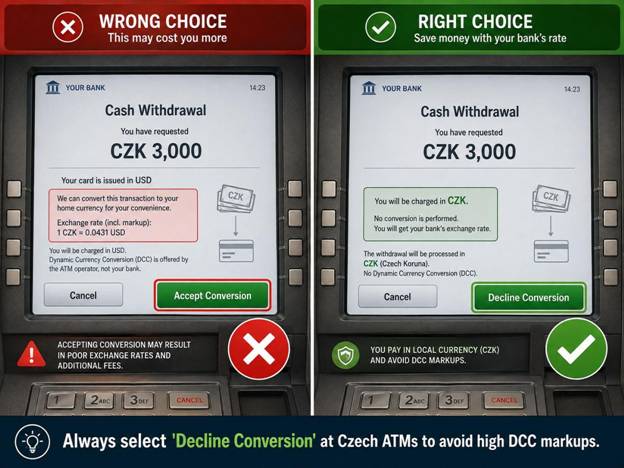
Dynamic Currency Conversion (DCC) represents one of the most expensive pitfalls in international travel finance, deceptively framed as a customer convenience.
When paying by card or using an ATM, the terminal frequently offers to charge the transaction in the user's home currency instead of CZK. The exchange rate used for DCC is dictated by the merchant's bank or the ATM operator, not the traveler's home bank. Independent ATM tests conducted in Czechia during 2026 recorded DCC markups ranging from 6.51% to 19.00%, with an average penalty across providers of roughly 12.6%. Card-terminal DCC at retail locations tends to run slightly lower, usually between 3% and 5%, but still guarantees a financial loss.
Always press "Decline Conversion", "Continue without conversion" or select "Pay in CZK". This action ensures the home bank processes the exchange at the much lower mid-market rate, bypassing the operator's inflated margins entirely.
Street Exchange Dangers
Never exchange money with individuals approaching pedestrians on the street, especially near major tourist sites like Old Town Square, Charles Bridge, or Prague Castle. Scammers operating in these areas offer incredibly high rates and enthusiastically handle the transaction, only to hand over worthless, outdated currencies from other countries instead of Czech Koruna.
Victims frequently report receiving expired Belarusian rubles, which hold zero legal or financial value. This practice is a common, highly organized, and illegal scam. The only safe exchange options are licensed bureaus with visible registration credentials or official bank ATMs. The European Consumer Centre (ECC) continuously publishes travel warnings regarding these specific street exchange scams across Eastern Europe, urging tourists to rely solely on regulated financial institutions.
Understanding the Czech Currency (CZK)
Valid Banknotes and Coins in Circulation
Familiarizing oneself with the physical currency prevents the accidental acceptance of counterfeit or obsolete money. The Czech National Bank acts as the exclusive issuer of all Czech banknotes and coins, governed under Act No. 6/1993.
Currently valid Czech banknotes come in denominations of 100, 200, 500, 1000, 2000, and 5000 CZK. Valid coins include 1, 2, 5, 10, 20, and 50 CZK. It is critical to note that the 50 CZK paper banknote was invalidated and entirely withdrawn from circulation on March 31, 2011, replaced by the 50 CZK coin. Any 50 CZK paper note presented during a transaction holds absolutely no value.
Why Hasn't the Czech Republic Adopted the Euro?
Despite joining the European Union in 2004, the Czech Republic has not yet adopted the Euro. This status stems from a deliberate, long-term macroeconomic policy choice.
The Czech government and the national bank maintain independent monetary policy, utilizing the Koruna to manage domestic inflation and ensure economic stability against external shocks. In recent assessments, the Finance Ministry and CNB noted that multiple structural obstacles remain, including incomplete convergence in price and wage levels with the broader euro area, long-term fiscal pressures from infrastructure investments, and a lack of alignment with ECB legal requirements. Furthermore, Czechia remains outside ERM II, the mandatory exchange-rate mechanism that precedes euro adoption.
Consequently, the government ended its annual readiness-report process in 2026, setting no official adoption date. While businesses in heavily touristed areas occasionally accept Euros, the conversion rates applied are deliberately poor to discourage its use. Transactions must always be conducted in CZK to preserve value.
Frequently Asked Questions About Czech Koruna and Currency Exchange
Can I use Euros in the Czech Republic?
While some major hotels and tourist-facing shops accept Euros, the official currency is the Czech koruna (CZK). Paying in Euros usually results in a terrible exchange rate, as merchants apply heavy markups for the inconvenience of handling foreign cash. Using local cash or a travel card for any payment remains the only effective way to protect a travel budget.
What is the best way to get CZK?
The most cost-effective method involves withdrawing money from an official bank ATM using a card with zero foreign transaction fees. Alternatively, utilizing a reputable exchange office in the city center that offers a fair rate and charges zero commission provides excellent value. Avoid airport bureaus and independent tourist ATMs entirely.
How do I avoid high ATM charges?
Always decline Dynamic Currency Conversion (DCC). If the ATM asks to convert the transaction, select "Continue Without Conversion" or "Pay in CZK." This ensures the home bank calculates the fee, which is significantly cheaper. Avoid independent tourist ATMs (like Euronet), as they impose high flat withdrawal charges ranging from CZK 99 to CZK 239 for foreign cards.
Should I exchange money before I travel?
Exchanging money in a home country prior to departure often yields a poor currency value, as domestic banks and airport desks apply steep margins. Arriving in Czechia, using a contactless payment method for initial transport, and withdrawing CZK from an official bank ATM upon reaching the city center provides superior financial efficiency.
Are credit cards widely accepted?
Yes, Visa and Mastercard operate seamlessly in most restaurants, supermarkets, and attractions across major cities. However, carrying a small amount of physical koruna remains necessary for street food vendors, public restrooms, or rural areas where digital payment infrastructure lacks reliability. Combining card usage with a modest cash reserve forms the ultimate strategy for a stress-free trip. For comprehensive currency management and multi-currency account options, platforms like BankPro offer robust tools for handling international funds efficiently.
Quiz: Test Your Knowledge on CZK and Cash in Czechia
Question 1: Which ATM choice best helps avoid DCC in the Czech Republic?
- A. Accept conversion to your home currency.
- B. Choose CZK / "without conversion" (Correct).
- C. Choose the highest guaranteed rate Explanation: Financial authorities consistently advise declining Dynamic Currency Conversion and withdrawing in Czech koruna (CZK) so the home bank performs the conversion at a superior rate.
Question 2: What is the safest way to recognize valid cash in the Czech Republic?
- A. Any note with euros printed on it.
- B. Czech koruna (CZK) banknotes and coins (Correct).
- C. Only card payments are legal Explanation: The official currency used for cash payments is CZK. Valid Czech cash is issued exclusively in koruna, not euros, and the 50 CZK denomination exists only as a coin.
Question 3: Which ATM type is generally recommended for cash withdrawals in Czech cities?
- A. Bright tourist-area standalone ATMs like Euronet.
- B. Bank-branded ATMs from major Czech banks (Correct).
- C. Any machine advertising "0% commission" Explanation: Bank ATMs from major local institutions (e.g., Česká spořitelna, ČSOB) offer standard rates, whereas tourist-oriented machines frequently push aggressive DCC markups and high flat fees.
Date: 03.11.2026
Get your content published on BanksDAILY.com in just a few clicks.
- Updatings
- BNL BNP ParibasNovember 1, 2026
- HDFC BankNovember 1, 2026
- CA Auto BankNovember 1, 2026
- AikBankOctober 31, 2026
- Mox BankOctober 28, 2026
Smart Investing
Buy $BD digital coins and become an essential part of the BanksDAILY project! We create a culture of ownership using secure and fast blockchain technology!
More info...